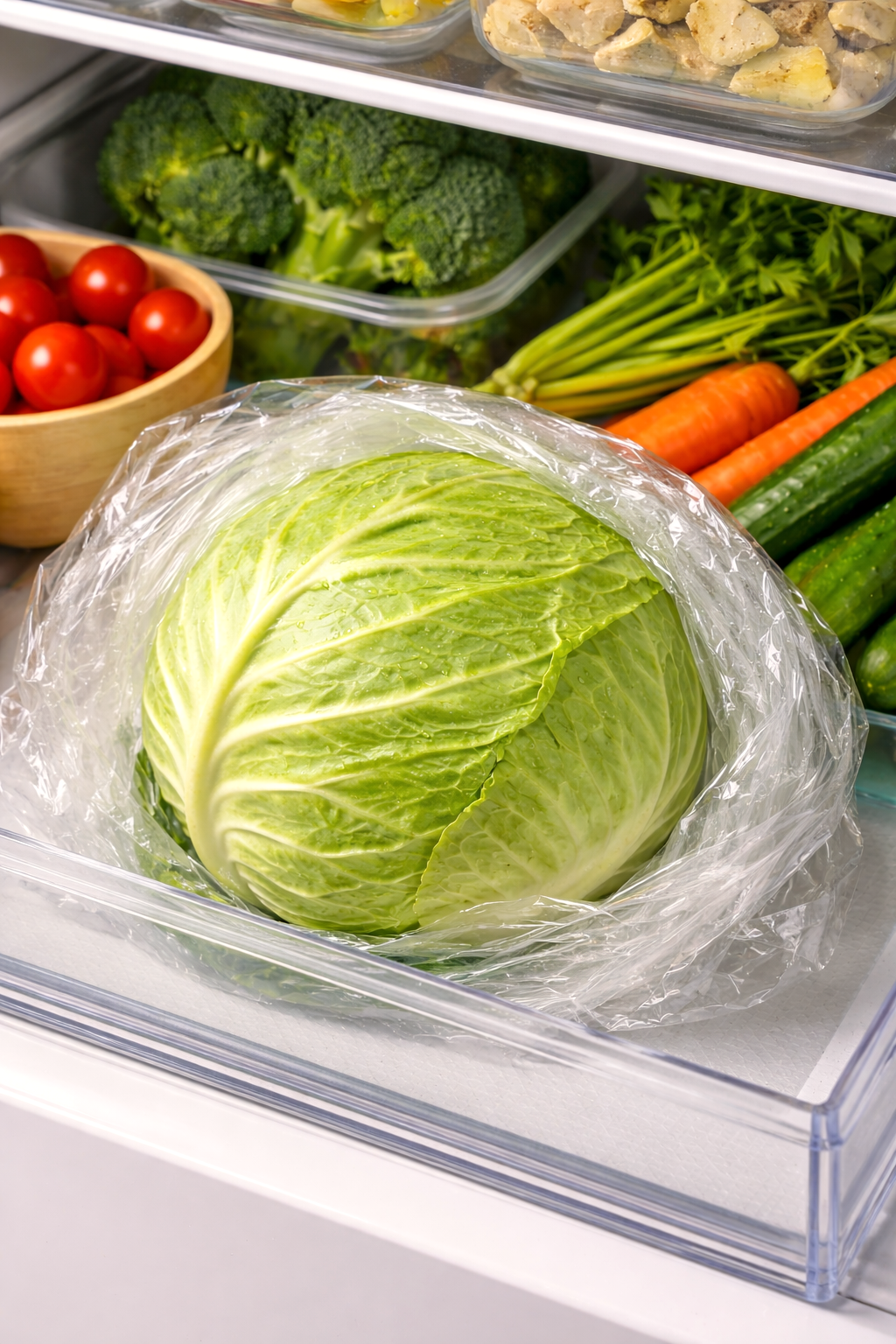
Knowing how to store cabbage correctly is the difference between two months of freshness and two days of waste.
Cabbage can last up to two months in your refrigerator. Most people get two weeks — if they’re lucky. The difference comes down to a few specific mistakes that are easy to avoid once you know what’s actually happening to the cabbage in your fridge.
This guide covers exactly how to store cabbage in every form — whole, cut, shredded, cooked, and frozen — with the reasoning behind each rule so you understand why it works, not just what to do.
How Long Does Cabbage Last? Quick Reference
- Whole cabbage, refrigerated: 3–6 weeks (up to 2 months at ideal temperature)
- Cut cabbage, refrigerated: 3–5 days
- Shredded cabbage, refrigerated: 2–3 days
- Cooked cabbage, refrigerated: 3–4 days
- Blanched and frozen: 9–14 months
- Frozen without blanching: 1–2 months
- Savoy or Napa cabbage, refrigerated: 1–2 weeks
Why Cabbage Goes Bad — And Why the Cut Makes Such a Big Difference
Cabbage is a living vegetable. Even after harvest, it continues to respire — consuming its own stored energy and releasing moisture and carbon dioxide in the process. The faster it respires, the faster it deteriorates. Three things control the rate of respiration: temperature, air exposure, and moisture.
The moment you cut into a cabbage, you rupture thousands of cells simultaneously and expose the inner tissue directly to oxygen. This triggers oxidation — the same process that turns a sliced apple brown — across the entire cut surface at once. Moisture escapes rapidly. Bacteria find easy entry points. What was a 2-month vegetable becomes a 3-to-5-day one.
A whole head avoids this entirely. The outer leaves act as a natural protective barrier — slowing moisture loss, blocking bacterial entry, and insulating the inner leaves from temperature fluctuation. This is why the single most important cabbage storage rule is: don’t cut it until you need it.
There’s one more factor most storage guides miss: ethylene gas. Apples, bananas, pears, and avocados naturally release ethylene — a ripening compound that accelerates deterioration in nearby vegetables. Cabbage stored next to a fruit bowl or on the same shelf as ethylene-producing fruit will go bad significantly faster. Keep them separated.
According to research published in PMC, storage conditions significantly affect the nutritional quality and antioxidant capacity of vegetables including cabbage.
How to Store a Whole Head of Cabbage
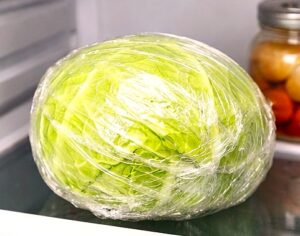
A whole, uncut cabbage is remarkably forgiving to store. The outer leaves do most of the work — leave them on.
- Don’t wash it before storing. Surface moisture encourages mold. Wash only right before use
- Don’t remove the outer leaves. They’re not waste — they’re the cabbage’s natural packaging and moisture barrier
- Store in the crisper drawer. Higher humidity slows moisture loss significantly compared to open fridge shelves. Set the drawer to high humidity if adjustable
- Use a loose plastic bag if your crisper runs dry. A loosely sealed bag retains humidity without trapping condensation that causes rot
- Store away from ethylene-producing fruit. Separate shelf from apples, bananas, and pears
- Keep toward the back of the fridge. The back maintains more consistent temperature than the door or front shelves
Stored this way: green or red cabbage lasts 3 to 6 weeks, up to 2 months near 32°F. Savoy and Napa cabbage last 1 to 2 weeks due to their looser, more delicate leaf structure.
How to Store Cut Cabbage
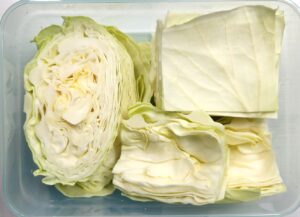
Once cut, the priority is minimizing air contact on the exposed surface. Every minute the cut side is open to air, oxidation is happening.
- Wrap the cut side tightly in plastic wrap, pressing it directly against the surface to eliminate air pockets
- Or place in an airtight container, cut side down — this reduces the surface area in contact with air
- Store in the coldest part of the fridge — back of the bottom shelf, not the door
- Use within 3 to 5 days
Don’t store cut cabbage loosely in the crisper without wrapping. The humidity helps with moisture retention, but it can’t compensate for direct air exposure on the cut surface.
How to Store Shredded Cabbage
Shredded cabbage has the shortest refrigerator shelf life because shredding maximizes the surface area exposed to oxygen — every cut edge is oxidizing simultaneously.
- Place in an airtight container or sealed zip-lock bag
- Remove as much air as possible before sealing
- Store in the coldest part of the fridge
- Use within 2 to 3 days
Shred as close to serving time as possible. Pre-shredded bags from the store follow the same rule — once opened, use within 2 to 3 days regardless of the package date.
Signs it’s gone bad: browning or grey discoloration, slimy texture, wilted appearance, or a sour smell. At that point, discard.
How to Store Cooked Cabbage
Cooking breaks down cell structure, making cooked cabbage more susceptible to bacterial growth than raw. It needs more careful handling.
- Refrigerate within 2 hours of cooking
- Store in an airtight container
- Use within 3 to 4 days
Cooked cabbage in sauce or broth may deteriorate slightly faster than plain cooked cabbage due to the added moisture.
Can You Freeze Cabbage?
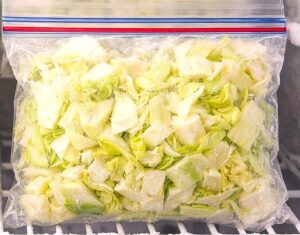
Yes — and frozen cabbage lasts significantly longer than refrigerated. The important caveat: freezing ruptures cell walls, so thawed cabbage is noticeably softer. It works well in soups, stews, stir-fries, and stuffed cabbage rolls — not for raw applications like coleslaw.
How to freeze cabbage correctly:
- Remove damaged outer leaves
- Cut into wedges, shreds, or the size you’ll use when cooking
- Blanch first: boil for 90 seconds, then immediately transfer to ice water. This deactivates the enzymes that cause quality loss during freezing. Skipping this step leads to mushy, discolored cabbage after thawing
- Drain and pat completely dry — excess moisture causes ice crystals and freezer burn
- Spread on a baking sheet and freeze for 1 to 2 hours before transferring to freezer bags (prevents clumping)
- Remove air from bags before sealing and label with the date
Blanched and frozen cabbage keeps for 9 to 14 months. Frozen without blanching: about 1 to 2 months before quality declines.
How to Tell If Cabbage Has Gone Bad
Cabbage gives clear signals:
- Yellowing outer leaves: Normal aging — peel them off and check inside. The inner leaves are usually fine
- Grey or black discoloration on inner leaves: Discard
- Smell: Fresh cabbage has a mild, slightly earthy scent. Sour or ammonia-like smell means discard
- Slimy texture: Not just wilting, but actual breakdown — discard
- Mold on stem or inner leaves: Discard the whole head
Mild surface browning on a cut edge isn’t necessarily spoilage — trim it off and check the interior. If the inner leaves look and smell fine, the cabbage is still good.
The Most Common Cabbage Storage Mistakes
Most cabbage goes bad prematurely because of these:
- Washing before storing. Surface moisture encourages mold — wash right before use, not before refrigerating
- Storing near ethylene-producing fruit. Apples, bananas, and pears speed up deterioration significantly
- Cutting more than you need. Every cut accelerates the clock — cut only what you’ll use immediately
- Leaving cut cabbage unwrapped. Even 30 minutes of air exposure starts the browning process — wrap immediately
- Storing on the fridge door or front shelf. These spots fluctuate in temperature every time the door opens. Use the back of the crisper or bottom shelf
- Removing the outer leaves before storing. They’re protecting the inner leaves — leave them on until you cook
The Bottom Line on How to Store Cabbage
Cabbage is one of the most storage-friendly vegetables available — but the gap between storing it correctly and storing it carelessly is measured in weeks, not days. Keep it whole as long as possible. Wrap any cut surfaces immediately and airtight. Store cold, humid, and away from ethylene-producing fruit. Follow those four rules and a head of cabbage can realistically last you two months.
Related reading:
- Raw vs. Cooked Cabbage: Which Is Actually Better for You?
- Cabbage Juice Benefits: What the Research Actually Says
- What Happens When You Eat Cabbage Every Day